
Anatomy of the intestine
Insight into the hidden wonders of our body
Reading time approx. 4 minutes
Functions and structure of the intestine – the largest internal organ in the human body
The intestine – often and correctly referred to as the “second brain” – plays a central role in our overall well-being. But behind this sober description lies a highly complex, living system that controls far more than just digestion. The gut is an all-rounder: it processes food, protects against pathogens, communicates with our immune system and even influences our emotions and therefore our mood. But what does this masterpiece of nature actually look like?
From the stomach to the anus – the intestine in its full length
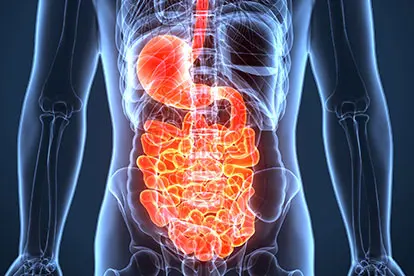 The intestine begins where the stomach has completed its task and ends at the anus. It is not a simple tube, but a versatile organ that is divided into two large sections: the small intestine and the large intestine. Each of these sections is a small universe in itself, equipped with unique functions that keep us alive every day. The real magic of digestion happens in the small intestine. This narrow but extremely long part of the intestine could be described as the body’s “main workshop”. This is where food is broken down into its smallest components so that our body can absorb valuable nutrients such as vitamins, minerals and energy. The small intestine can be divided into three sections, which work like coordinated stations in a sophisticated manufacturing process. The first part is the duodenum, where the food is thoroughly prepared for its onward journey. Like a chemistry lab, the duodenum mixes digestive juices from the liver and pancreas to break down fats, proteins and carbohydrates. The empty intestine then takes over, absorbing the valuable nutrients and passing them on to the bloodstream. Finally, the large intestine ensures that even the last valuable components, such as vitamin B12, are not lost.
The large intestine – water, balance and the final shaping
After the work of absorbing nutrients in the small intestine has been completed, the food pulp reaches the large intestine. This is where the intestine’s task changes: it becomes the “recycling master”. While the small intestine is responsible for absorbing nutrients, the large intestine draws out the remaining water and transforms the chyme into its final form – stool. It is as if the final quality control takes place here before the leftovers leave the body. The large intestine is also divided into different sections, each of which fulfills its own important function. The cecum may seem like a forgotten storage room at first glance, but scientists suspect that it may house a kind of “backup system” for beneficial gut bacteria. These bacteria in turn play a central role in the large intestine, where they further break down food components and help us get the most out of what we have eaten. At the end of the large intestine, in the rectum, the final storage of the stool takes place. This is the moment when the bowel finishes its digestive work and the last remnants of digestion leave the body. But until then, this organ has accomplished a masterpiece that keeps us alive every day.
The intestinal wall – a finely tuned barrier
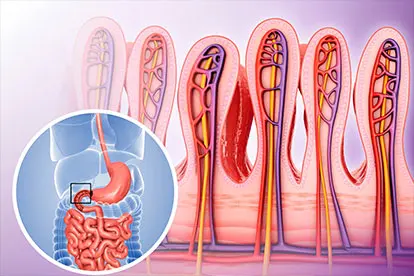 But what keeps all this in motion? The intestine itself consists of different layers, each of which has its own task. You can imagine the intestine as a highly complex fortress in which every wall and every stone is perfectly coordinated. The inner layer, the mucous membrane, is the star of the system. It is studded with tiny finger-like protrusions, the villi, which, like little antennae, pick up every trace of nutrients from the food. This layer is the intermediary between the food and our body, ensuring that only what is valuable reaches our blood. The muscle layer underneath provides the rhythmic movements that gently but firmly push the food pulp through the intestine. You could say that the intestine is not only a master of chemistry, but also a dancer that guides the food through the body with flowing movements. These movements, known as peristalsis, prevent food from getting stuck and ensure that each section of the intestine can do its job perfectly.
The intestinal flora – our inner ecosystem
While the intestine carries out its mechanical and chemical work, an invisible army of microorganisms works tirelessly. The intestinal flora – a densely populated ecosystem of trillions of bacteria, fungi and other microorganisms – is our body’s secret ally. These microscopic helpers support our digestion, protect us from harmful intruders and train our immune system. The small intestine is home to a sensitive community of microorganisms that maintain the balance in this section. In the large intestine, however, the full potential of the microflora unfolds: more microorganisms live here than in any other part of the body. They produce vitamins, break down fiber and provide important substances that serve as a source of energy for the cells of the intestinal mucosa.
The intestine as a miracle of nature
The gut is therefore not only the center of our digestion, but also a key player in our health and well-being. It is like a well-oiled gearbox that works smoothly and efficiently to provide us with everything we need to live. Its complex anatomy and close cooperation with the intestinal flora make it one of the most fascinating and at the same time underestimated organs of our body. Anyone who understands how this marvel works will realize that a healthy gut is the key to a healthy life.


