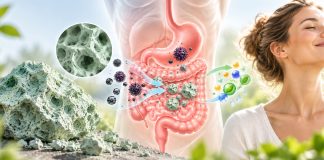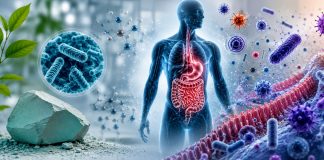
A new study confirms zeolite’s high capacity to bind lead – and the issue of environmental toxins is leading to a paradigm shift in medicine.
For now, we mostly talk about blood sugar, cholesterol, and blood pressure. We test our vitamin D levels, discuss omega-3s, exercise, and longevity. We optimize our sleep, monitor our heart rate, and most people are now familiar with the term “microbiome” and know that it should be nourished with probiotics. Slowly but surely, the volcanic mineral zeolite is also entering the picture – this time not from the realm of alternative medicine, but from scientific research. The increased focus on zeolite in scientific research has highly relevant and urgent reasons.
Do you actually know how much lead, cadmium, mercury, or arsenic is in your body?
Probably not (yet).
Until recently, this was one of the major oversights of modern preventive medicine, and this is hardly surprising: Only in the past few years have numerous valid studies and investigations been published that no longer dismiss heavy metal exposure as a “minor issue,” but rather highlight its significant role in the causes of countless diseases.
Research into the causes – and, consequently, the evaluation of possible treatments – is of the utmost urgency, because the prevalence rates of cardiovascular diseases, cancer, Alzheimer’s, other forms of dementia, and Parkinson’s have never been as high as they are today. The same applies to neurophysiological disorders such as depression and anxiety disorders.
Heavy metals are therefore no longer just a marginal topic in alternative medicine; rather, corresponding tests are increasingly being used in medical practices across various specialties. And for good reason: Environmental toxins are now linked to approximately nine million premature deaths worldwide each year; toxic metals such as lead, cadmium, arsenic, and mercury are explicitly among the most significant pollutants. The WHO now estimates that lead alone will account for approximately 1.5 million attributable deaths in 2021.
The Age of Lead – Lead Is Now Everywhere
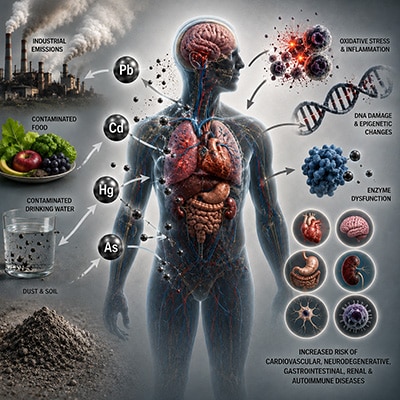
We know that lead is toxic. The fact that we have therefore banned leaded gasoline, replaced water pipes, and introduced limit values for food was undoubtedly a step forward. The problem is that this is not enough, because lead has not disappeared from our environment as a result. Quite the contrary: this highly toxic heavy metal enters the environment through industry, mining, batteries, and ammunition; it is found in soil and dust and can be absorbed by humans primarily through food, drinking water, and the air we breathe.
The Austrian Agency for Health and Food Safety (AGES) therefore explicitly describes lead as “ubiquitous,” meaning it is everywhere. Let’s take our food as an example: In 2020, according to AGES, lead levels above the limit of quantification were found in 232 out of 411 food samples tested; for tea, the figure was 93 percent, and for cheese and cheese products, it was all samples.
And even legal limits do nothing to change the unpleasant biological reality:
Lead accumulates, meaning it can build up over years and decades – particularly in the bones – damaging the nervous system and affecting organs. This is because not only the dose but also the duration plays a toxic role: AGES cites a half-life of ten to 30 years for inorganic lead in the bones.
During pregnancy, breastfeeding, or periods of increased bone resorption, the stored lead can be mobilized again and released into the bloodstream. The Swiss Federal Office of Public Health also points out that stored lead can reach the fetus even during pregnancy and can also enter breast milk.
The issue is not acute poisoning – but chronic exposure
 When we think of lead and our health, we instinctively imagine acute lead poisoning: a high dose, dramatic symptoms, an immediate medical emergency. But these are isolated cases, and today, a completely different question is relevant in environmental medicine: What happens to us even with low but continuous exposure over years and decades?
The World Health Organization (WHO) describes lead as a cumulative toxin that can impair the neurological, hematological, cardiovascular, and renal (i.e., kidney) systems. Particularly problematic: According to the WHO’s assessment, there is no known exposure level that is completely free of harmful effects, because even the smallest amounts of lead are sufficient to damage the body – it is, quite simply, a pure poison for both humans and animals.
Science is now also painting a much more complex picture of other heavy metals. A major recent review article in *Archives of Toxicology* describes, among other things, the oxidative stress, enzyme dysfunction, DNA damage, and chronic inflammatory mechanisms triggered by these metals, and discusses links to gastrointestinal, renal, and neurodegenerative diseases. A meta-analysis involving approximately 348,000 people also found links between lead, arsenic, and cadmium and an increased risk of cardiovascular disease.
Autoimmune diseases and poisoning from environmental factors are also increasingly being studied. Among other things, heavy metals can promote epigenetic changes and influence innate and adaptive immune responses; and links are being discussed, for example, with rheumatoid arthritis, lupus, and multiple sclerosis. This explicitly does not mean that heavy metals “cause” these diseases on their own, but they play a more significant role than previously assumed.
In general: The earlier notion that chronic diseases could generally be reduced to a single trigger no longer reflects the current state of knowledge. Rather, nearly all clinical pictures are systemic, meaning that many causal factors play a role, and environmental toxins are one of these central factors.
Paradigm Shift: Environmental Medicine Is Increasingly Becoming an Integral Part of Identifying Causes
Nowadays, environmental exposure often begins even before a person is born.
Even in the womb, the unborn child is exposed to toxic substances via the mother’s blood. In general, children are the most vulnerable group: Their nervous system is still developing, and lead, in particular, severely affects this system. According to an analysis by UNICEF and Pure Earth, an estimated 800 million children worldwide have blood lead levels of at least 5 µg/dl. That corresponds to roughly one in three children.
This also explains an observation that doctors specializing in environmental medicine are now reporting to us with increasing frequency: Those who specifically test for heavy metals and other environmental toxins almost always find them in patients with chronic illnesses. Conversely, this naturally means that substances not tested for in a standard blood test cannot be detected there. Heavy metals, pesticides, and other environmental toxins are not yet automatically included in standard diagnostic procedures, but scientists are urgently calling for their inclusion, and heavy metal tests are increasingly being used in private practices as well.
Particularly in the field of prevention – which is more important than ever – expanded blood tests offer us new and, above all, early-stage opportunities to counteract environmental exposure. Of course, not everyone needs to undergo every conceivable contaminant screening indiscriminately – there’s no need for hysteria. However, given the growing body of evidence, it seems increasingly plausible to also consider environmental exposure when dealing with unexplained, chronic, or complex clinical pictures. And another key takeaway emerges from this: an unassuming, million-year-old mineral is suddenly cutting-edge and sparking heightened interest in the scientific community.
New study proves once again: Zeolite binds lead particularly well
In late July 2026, scientists from South Africa published a new study on natural, clinoptilolite-rich zeolite. The researchers wanted to know how reliably the volcanic mineral can bind and remove particularly problematic heavy metals – lead and cadmium.
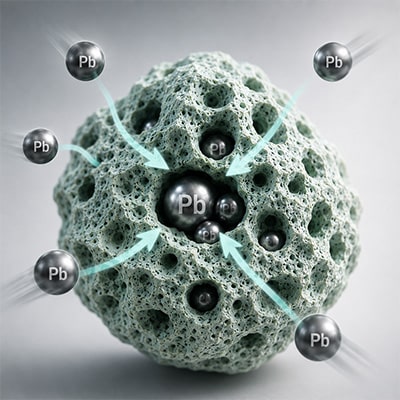
The results were clear: The clinoptilolite zeolite adsorbed both metals and exhibited a particularly high affinity for lead. The modeled maximum adsorption capacity was approximately 10.94 milligrams of lead per gram of zeolite, compared to 7.70 milligrams per gram for cadmium. This is not due to some mysterious “detox effect,” but simply to chemistry.
As is well known, zeolite rock has a microporous, three-dimensional aluminosilicate structure with a negative net charge. This allows it to bind positively charged ions – known as cations – or exchange them for other cations. The authors of the new study attribute the observed heavy metal binding specifically to this ion exchange and electrostatic interactions. As in previous studies, this once again demonstrates one of the fundamental physicochemical properties of this mineral: zeolite can efficiently bind lead and other pollutants in the gastrointestinal tract – in a measurable, reproducible manner and with pronounced selectivity (more on this: What is clinoptilolite zeolite?).
It is no coincidence that scientific research into these properties of clinoptilolite zeolite is increasing worldwide today. The need for effective detoxification in medicine has become too urgent – not, as is so often the case, for an elite few, but for the general population – meaning it must be easy to use and affordable.
Zeolite: From a Ridiculed “Detox Powder” to a Scientifically Studied Adsorbent
 For years, zeolite was relegated to the realm of alternative medicine, likely primarily because the rock cannot be classified into any known category – after all, it is neither a medication nor a plant-based substance. In the process, people lost sight of the fact that zeolite is something truly fascinating and unique in nature: a natural adsorbent and ion exchanger with precisely defined physicochemical properties.
Once this has been (re)discovered, it elevates zeolite to a whole new level, which is another reason why scientific interest in this volcanic rock continues to grow. After all, what could be simpler and more effective than binding and removing toxic substances such as lead, other heavy metals, and toxins right in the gut – even before these contaminants can spread throughout the entire body – and all without directly interfering with metabolism? Whether for prevention, as a “basic tool” in longevity strategies, or as an adjunct treatment for chronic diseases, zeolite is therefore making a name for itself with significantly greater prominence.
However, a clear distinction must be made: Not every natural zeolite is equally suitable for oral intake. With medically processed forms such as the standalone active ingredient “PMA-Zeolite,” the differences go far beyond simply the mineral’s name: particle size, purity, contaminant control, a patented processing method – which further increases absorption capacity and makes the zeolite particularly well-tolerated by the human body – as well as clinical studies clearly distinguish this form of zeolite from conventional zeolite products. Doctors who primarily use or recommend PANACEO’s PMA-Zeolith in their practices are well aware of this, as PMA-Zeolith is available at every pharmacy.
Not Just Exercise and Sleep: Prevention in 2026 Must Also Mean Environmental Prevention
Unfortunately, we will not be able to rid our environment of pollutants overnight – even if the will to do so, including in politics and business, were actually there.
For now, the following applies: We are now reaping what we have sown in recent decades. That is why modern prevention will have to fulfill two tasks simultaneously in the future: reduce exposure as much as possible, primarily by paying attention to the quality of our diet -and support the body sensibly and regularly in ridding itself of all these burdens. Read more about the extensive topic of prevention here: Prevention.
Sources and further reading:
AGES – Austrian Agency for Health and Food Safety: “Lead” / Studies on Lead Exposure via Food
AGES describes lead as ubiquitous – that is, a heavy metal found practically everywhere in the environment. It can be ingested through food and drinking water, among other sources, and can accumulate in the body over the long term. Austrian study data from 2020 are particularly noteworthy: Lead was detected above the limit of quantification in 232 of 411 food samples tested; for tea, this was 93 percent of the samples, and for cheese and cheese products, all samples tested. For inorganic lead, AGES reports a biological half-life in bone of approximately 10 to 30 years.
Link: https://www.ages.at/mensch/ernaehrung-lebensmittel/rueckstaende-kontaminanten-von-a-bis-z
Moja, T. N. et al.: “Sustainable sequestration of Pb(II) and Cd(II) by South African clinoptilolite: mechanistic insights, nonlinear modeling, and multi-cycle reusability,” Chemical Papers, 2026
The study, published in July 2026, serves as the current basis for our article. It examined natural, clinoptilolite-rich zeolite with regard to its ability to adsorb lead and cadmium from aqueous solutions. Clinoptilolite demonstrated a particularly high affinity for lead; the scientists identified ion exchange and electrostatic interactions as the key mechanisms. The study was conducted outside the human body and therefore does not allow for direct conclusions regarding lead removal in humans.
Link: https://link.springer.com/article/ 10.1007/s11696-026-05300-8
Kraljević Pavelić, S.
et al.: “Clinical Evaluation of a Defined Zeolite-Clinoptilolite Supplementation Effect on Selected Blood Parameters of Patients,” Frontiers in Medicine, 2022
The study investigated the intake of medically processed PMA zeolite using data from three clinical trials with varying durations of intake – ranging from 28 days to twelve weeks to four years. The focus was particularly on the concentrations of physiologically relevant minerals and various metals in the blood. After short-term use, the scientists found no evidence that lead or aluminum were released from the PMA zeolite into the bloodstream. With long-term use, levels of aluminum and nickel, among others, decreased significantly; in patients with Crohn’s disease, a significant decrease in arsenic was measured after twelve weeks. For lead, the long-term study showed a more complex pattern: initially higher blood levels, which the authors attributed to possible mobilization from the bones as part of bone remodeling; later, the levels decreased significantly again. The authors expressly emphasize that these results pertain specifically to the specially processed PMA zeolite and cannot be generalized to other clinoptilolite products without further clinical investigations.
Link: https://www.frontiersin.org/journals/medicine/articles/10.3389/fmed. 2022.851782/full
Jomova, K. et al.: “Heavy metals: toxicity and human health effects,” Archives of Toxicology, 2025;
This comprehensive, up-to-date review summarizes the current state of research on the toxicity of various heavy metals. Among other things, it describes oxidative stress, impairments of enzymes and cellular functions, DNA damage, and inflammatory processes. The authors discuss the health effects of heavy metals on numerous organ systems and their possible role in chronic diseases.
Link: https://link.springer.com/article/ 10.1007/s00204-024-03903-2
Chowdhury, R. et al.: “Environmental toxic metal contaminants and risk of cardiovascular disease: systematic review and meta-analysis,” BMJ, 2018
The systematic review and meta-analysis evaluated 37 studies with a total of 348,259 participants.
Higher levels of exposure to arsenic, lead, and cadmium were associated with an increased risk of cardiovascular disease. Some associations were particularly pronounced for lead: For example, when comparing the highest exposure levels with the lowest, an increased risk of cardiovascular disease, coronary heart disease, and stroke was observed.
Fuller, R. et al.: “Pollution and health: a progress update,” The Lancet Planetary Health, 2022
The international analysis updated the data from the Lancet Commission on Pollution and Health. According to the analysis, environmental pollution continued to be associated with approximately nine million premature deaths per year. Modern forms of pollution, including exposure to toxic chemicals and heavy metals, have become particularly significant.
World Health Organization (WHO): “Exposure to lead: a major public health concern,” 4th edition, 2025
The WHO classifies lead as a cumulative toxin that can affect, among other things, the neurological, hematological, gastrointestinal, cardiovascular, and renal systems. Children are considered particularly at risk due to the special sensitivity of their developing nervous systems. According to updated IHME estimates, approximately 1.5 million deaths worldwide in 2021 were attributed to lead exposure, primarily due to cardiovascular consequences.
WHO Regional Office for Europe: “Human health effects of benzene, arsenic, cadmium, nickel, lead, and mercury,” 2024
The report from a WHO expert consultation provides a comprehensive overview of exposure pathways and health effects of key environmental contaminants. For lead, the report describes, among other things, associations with cardiovascular, hematological, neurological, reproductive, and renal effects. For arsenic, cadmium, lead, nickel, and mercury, diet represents a major exposure pathway.
Link: https://www.who.int/switzerland/publications/i/item/WHO-EURO-2023-8983-48755-72523
UNICEF/Pure Earth: “The Toxic Truth: Children’s Exposure to Lead Pollution Undermines a Generation of Future Potential,” 2020
The report draws particular attention to lead exposure among children. According to the underlying estimates, up to 800 million children worldwide – roughly one in three – have blood lead levels of at least 5 µg/dl. Lead is considered a highly problematic neurotoxin, especially for infants and toddlers, as their brains and nervous systems are still developing.
Link: https://www.unicef.org/reports/toxic-truth-childrens-exposure-to-lead-pollution-2020