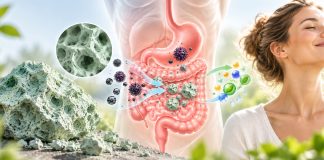
Gut-brain axis and depression – Why detoxification with zeolite as a building block can help
Depression has long been one of the most widespread illnesses. According to the German Depression Aid Foundation, around 5.3 million adults between the ages of 18 and 79 are affected by a unipolar or persistent depressive disorder in Germany every year. This corresponds to around 8.2 percent of the population. Extrapolated over a lifetime, depression affects around one in five to six people at least once, according to various studies. In Austria, the situation is no different in relation to the population: Depending on how you read it, around 400,000 to 730,000 people are affected here.
The number of unreported cases is high and the number of people affected in each age group is rising rapidly. Across Europe, it is now estimated that over 50 million people suffer from depression in the course of their lives. The suffering – the deep exhaustion, the lack of drive, the withdrawal, the disappearance of joy – is often invisible but enormous. And while antidepressants and psychotherapy are supposed to alleviate the symptoms, one central question remains unanswered far too often:
Where does depression actually come from – and why does hardly anyone talk about the role of the gut?
Only in recent years has it become clear that emotional balance is much more than just a problem of brain chemistry. The so-called gut-brain axis, a highly complex communication system between the head and the gut, is increasingly becoming the focus of scientific attention. At the center of this axis: the intestinal barrier – and an ancient natural mineral called zeolite, which starts exactly where mental health or illness can begin.
The gut as a neurotransmitter factory: Why serotonin, dopamine & Co. are not only produced in the head
For a long time, the brain was regarded as the sole seat of emotions and, particularly in the case of depression, doctors focused almost exclusively on the so-called “happiness hormone” serotonin. A lack of this – so the common theory – was the main cause of depressive moods. But this view falls short. Because recent studies show: Up to 90 percent of the body’s serotonin is not produced in the brain, but in the intestines.
To be more precise: serotonin is produced in the enterochromaffin cells of the intestinal mucosa, stimulated by certain intestinal bacteria and nutrients. Where the microbiome, immune system, nervous system and intestinal barrier overlap, a complex neurochemical network is created that goes far beyond the production of serotonin. Other neurotransmitters that influence our mood – such as dopamine (motivation), GABA (calming) and even noradrenaline (drive) – are also directly or indirectly linked to gut function.
When the gut rebels: Irritable bowel syndrome as an underestimated risk factor for psychological complaints
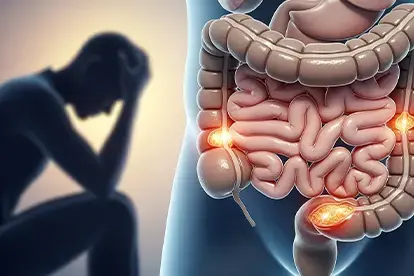
If the intestinal barrier becomes permeable and the microbiome becomes unbalanced and inflammation occurs, the production and effect of these neurotransmitters changes and so-called “irritable bowel syndrome” can also develop. What sounds so harmless should not (any longer) be underestimated: According to recent surveys, over 11 million people in Germany suffer from it – this corresponds to around 14 percent of the population and the trend is rising.
A large-scale study in Belgium even found that around 70 percent (!) of the population suffer from recurring gastrointestinal complaints – a frighteningly high figure that can also be transferred to other Central European countries such as Germany or Austria due to comparable lifestyle habits and dietary patterns.
This makes it clear that the “inner turmoil” of the gut is no longer a niche problem, but a silent epidemic. And this is exactly where the path to the soul and depression begins: the more irritable the gut, the more disturbed the communication with the brain. This can result in an extremely “muted” emotional life. More and more researchers now agree that the development of depression often does not start in the head – but in the gut.
The gut-brain axis: How a silent conversation between the gut and brain determines our emotional life
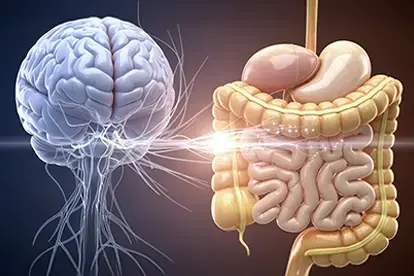
It sounds almost poetic – and yet it is pure biology: a permanent high-speed data highway runs between our brain and gut. The so-called gut-brain axis is a two-way communication link of fundamental importance in which nerve cells, hormones, messenger substances and immune cells constantly exchange information.
The central nerve bundle of this axis is the vagus nerve, which sends signals from the brain to the digestive tract as a kind of super conduit – and vice versa. Something that is often misunderstood: Around 80-90 percent of these signals run from the gut to the brain, not the other way around! So it is the gut that sets the tone. And the brain – amazingly enough – listens.
But that’s not all: the microbiome, i.e. the entirety of our gut bacteria, also plays a decisive role, of course. It not only influences the production of neurotransmitters, but also the activity of the immune system, which in turn provides feedback to the brain. If this finely tuned network is out of balance – for example due to chronic stress, poor nutrition, environmental pollution, pesticide residues or drugs such as antibiotics – the gut-brain axis can be derailed.
A harmless feeling of fullness then turns into a depressed mood, a chronic bloated belly into a constant circle of thoughts and a leaky gut into a depressive episode. Although research is still in the middle of this process, one thing is already clear: our emotional experience depends very much on the state of our gut. And stabilizing the gut can often also stabilize the soul.
What is often overlooked: A microbiome can only thrive if the intestinal barrier is intact
The microbiome has long since become a star in health guides, advertisements and even scientific conferences. And rightly so: the billions of bacteria and microbes in our gut control countless processes, from digestion to mood. But in this microbiome euphoria, one crucial factor is almost always forgotten – or only mentioned as a side note:
“The microbiome can only fulfill its tasks if it sits on a stable foundation. And this foundation is the intestinal barrier,“ explains neurologist and psychiatrist Frank Schmidt-Staub from Hanover: ”Imagine the intestinal wall as a living garden soil. Only if this soil is nutrient-rich, firm and permeable in the right places can good bacteria thrive, colonize, regenerate – and work. However, if this soil is full of holes, damaged or riddled with pollutants, even the best pre- and probiotics are of no use. The bacteria find no support, no food, no protection.”
In this context, Schmidt-Staub and many experts warn of a modern error: those who focus exclusively on the microbiome in the case of intestinal problems often only treat the symptom – but not the cause. This is because a damaged intestinal barrier not only allows important nutrients and protective substances to escape – it also allows toxins and inflammatory messengers to enter the bloodstream. And this can have fatal consequences for the body and mind.
Intestinal barrier – protective shield, border post and communication center all in one
Unfortunately, very few people know what the intestinal barrier actually is. The intestinal barrier is much more than just a “simple” wall: it is a highly complex protective system that decides what gets into our body and what has to stay out. You can think of it as an intelligent security center that checks, sorts and filters around the clock.
The intestinal barrier consists of several layers that work closely together
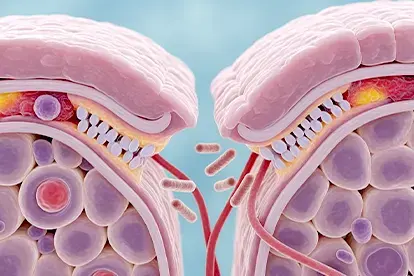
- The mucus layer (mucosa): This is the first barrier between the intestinal contents and the body. Important mucus-producing cells and certain bacteria that have an anti-inflammatory effect live here. The mucus layer protects the underlying cells from mechanical stimuli and toxic substances.
- The intestinal mucosa with the enterocytes: These cells line the intestinal wall. They sit close together – connected by so-called tight junctions. These prevent uncontrolled substances from entering the body through the intestinal wall.
- The underlying immune system: directly beneath the cell layer is an enormous network of immune cells. According to studies, around 70-80 percent of our entire immune system is located here – always ready to fight off dangerous intruders such as bacteria, viruses or toxins
- The enteric nervous system: Also known as the “abdominal brain”, it consists of over 100 million nerve cells. It is in close communication with the brain – via the aforementioned gut-brain axis – and reacts extremely sensitively to changes in the intestinal barrier.
Only if all these components work together smoothly will the intestinal barrier remain intact and the body in balance. If one of these levels is disturbed, a so-called “permeability disorder” occurs, i.e. pathological permeability of the intestinal wall. The technical term for this is leaky gut syndrome.
Leaky gut: when the gut becomes leaky – and the soul suffers as a result
The term leaky gut describes a disturbed intestinal barrier. Inflammatory substances, undigested food residues and toxins such as environmental toxins, pesticides or heavy metals such as cadmium, lead, copper or arsenic enter the bloodstream through tiny cracks in the intestinal wall. The immune system sounds the alarm. The result: chronic inflammation (“silent inflammation”) – including in the brain. Experts have long known that depressed people often have elevated inflammation markers in their blood. The connection? A disturbed intestinal barrier as a silent source of inflammation that ignites the psyche via the bloodstream.
Zeolite – the invisible foundation for a healthy gut and a stable emotional life
But what can be done to regenerate and protect the intestinal barrier and thus also the microbiome? As harmful substances have long since become part of our everyday lives, it is becoming increasingly important to provide the body with tools that protect it – not just when an illness such as depression already exists, but ideally before it develops. And this is precisely where the natural mineral zeolite unfolds its special effect.
This is because zeolite is not simply a means of intestinal cleansing – it is the basis for the foundation: for a stable intestinal barrier, a functioning microbiome and thus for healthy communication between the gut and brain.
What makes zeolite so special? Its crystalline honeycomb structure – like a sponge with a magnetic effect that specifically binds harmful substances in the intestine. Heavy metals such as lead, mercury or cadmium, but also ammonium (a degradation product of protein in the body that has a toxic effect in high concentrations) or pesticide residues that accumulate in the body can be bound by medically certified zeolite and excreted via the stool. On the contrary: the well-known PMA zeolite has even been shown in clinical studies to release minerals such as calcium and magnesium back into the body.
But zeolite can do even more: clinical studies show that PMA zeolite, a micro-activated, clinically tested zeolite, stabilizes the integrity of the intestinal barrier and contributes to regeneration. And this is precisely what is crucial – because only an intact intestinal barrier enables the microbiome to colonize, communicate and positively influence the brain.
Frank Schmidt-Staub puts it in a nutshell: “If we want to clean up the brain, we have to start in the gut. Zeolite can create an important basis here – especially for patients who are struggling with chronic stress or environmental toxins.”
And anyone who thinks that only people with leaky gut syndrome or diagnosed irritable bowel syndrome should use zeolite is mistaken: we are all exposed to pollution every day – be it through particulate matter, contaminated drinking water, pesticides in food or medication. Even small children are affected – as can be seen from the increasing number of allergic diseases or the massive rise in the number of young people who are already suffering from depression.
It is precisely in this situation that the true value of zeolite becomes apparent: not only as an aid in acute cases, but also as a means of prevention. Taking zeolite is a natural way to relieve the intestines, protect the intestinal wall and detoxify the body – before symptoms arise. After all, only those who protect the root can make the crown of the tree blossom.
Understanding depression means thinking and acting holistically
Let’s summarize: Looking at the gut-brain axis changes our understanding of mental health. Those who locate depression solely in the head overlook its central control organ for our feelings and emotions – the gut. And those who only fight symptoms without stabilizing the terrain are tilting at windmills. Zeolite can be a silent but effective partner here.
What we need is more knowledge, including about the intestinal barrier and the possibilities of zeolite
Depression is not a sign of weakness. It is a warning call from the entire system – physically, mentally and socially. What we need is a new understanding of the role of the gut, of the truly massive impact of environmental factors and of appropriate preventive strategies. Zeolite is not a panacea, but it is a reliable companion on the path back to balance. And that is often more than any pill can achieve.
Sources and studies:
Study: The microbiome-gut-brain axis in depression: the role of neuroinflammation
Source: Neurobiology of Disease, 2016
DOI: 10.1016/j.nbd.2015.04.012
Link: https://www.researchgate.net/publication/337658212_Gut_microbiota-brain_axis_in_depression_The_role_of_neuroinflammation
Comment: Fundamental work on the role of the gut-brain axis in depression.
Study: Gut microbiota regulates serotonin biosynthesis in the gut
Source: Cell, 2015
DOI: 10.1016/j.cell.2015.02.047
Link: https://www.cell.com/fulltext/S0092-8674(15)00248-2
Comment: Provides very clear evidence that around 90% of serotonin is produced in the gut – through microbial activation.
Study: The gut microbiome in depression and potential therapeutic implications
Source: Pharmacological Research, 2020
DOI: 10.1016/j.phrs.2019.104057
Link: https://www.sciencedirect.com/science/article/pii/S2352396423000920
Comment: Shows, among other things, that depressed people have an altered microbiome
Study: Intestinal permeability in inflammatory bowel disease and depression
Source: World Journal of Gastroenterology, 2020
DOI: 10.3748/wjg.v26.i21.2973
Link: https://www.researchgate.net/publication/363142228_Intestinal_Permeability_and_Depression_in_Patients_with_Inflammatory_Bowel_Disease
Comment: Shows the role of permeability disorder and its association with depressive symptoms.
Study: Environmental toxins and depression: a systematic review
Source: Environmental Research, 2022
DOI: 10.1016/j.envres.2022.113153
Link: https://www.sciencedirect.com/science/article/abs/pii/S001393512402067X
Comment: Underpins exposure to environmental toxins as a risk for depression.
Studies on this can be found in our “Zeolite studies” section:
https://www.zeolith-wissen.de/en/zeolite-studies