Why Our Liver Is Increasingly Overwhelmed and How the Active Ingredient PMA Zeolite Can Help Relieve It
There is hardly any organ in the human body that does as much yet receives as little attention as our liver. Day after day, it tirelessly filters toxins from the blood, processes nutrients, regulates metabolism, stores energy, and ensures that countless biochemical processes can run smoothly. And all of this happens silently, without pain, without warning signs, without the slightest indication that this vital organ might be reaching its limits. First, the good news: Zeolite – specifically PMA Zeolite, which has been optimized for the human body – is one of the most powerful supporters of the liver, as we will see. This is highly relevant to know, because the following figures show just how widespread the lifestyle disease fatty liver has become and continues to spread.
A new analysis from the “Global Burden of Disease Study,” published in the renowned journal “The Lancet,” paints a picture that could hardly be clearer: Already today, more than 1.3 billion people worldwide live with so-called metabolic fatty liver disease, and if current trends continue, this number could rise to nearly 2 billion (!) by the year 2050. What is described here is no longer a marginal phenomenon, but a silent global shift – a disease that does not announce itself loudly, but develops unnoticed inside the body and progresses over the course of years.
What exactly is fatty liver disease, and why does it go unnoticed for so long?
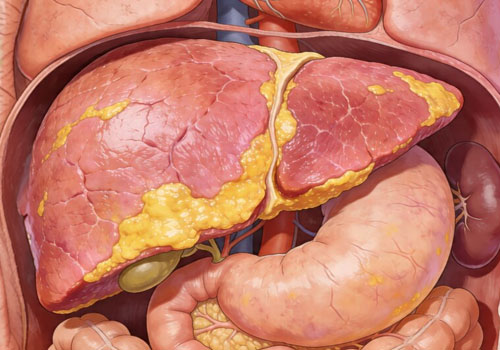 When doctors talk about a fatty liver, they simply mean that an excessive amount of fat is being stored in the liver cells. A fatty liver is diagnosed when more than about five percent of the liver’s mass consists of fat. What initially sounds like a mere “well, just a little fat” is actually a sign of an already profound metabolic disorder.
This is because the liver is the central organ of our fat and sugar metabolism. If this finely tuned system becomes unbalanced – for example, due to persistently elevated blood sugar levels, excessive calorie intake, or disrupted signaling pathways such as insulin action – the liver begins to store excess energy in the form of fat. The problem here is not so much the storage itself, but rather what can result from it. This is because the fatty liver cells alter their function, become more sensitive to stress, and are more susceptible to inflammatory processes. At the same time, this condition goes unnoticed for a long time, as the liver has virtually no pain receptors and its enormous regenerative capacity can compensate for many stresses and imbalances in the system over a long period.
This creates a paradoxical situation: While profound changes are already taking place inside the body, the person often feels completely healthy for a long time, and so the diagnosis often comes far too late.
And therein lies the real danger. For even if fatty liver itself causes no symptoms for a long time, it should by no means be underestimated: Over time, inflammatory processes can develop from it, which can lead to liver fibrosis, cirrhosis, or even liver cancer (see also: Zeolite for liver diseases). At the same time, it is often associated with what is known as metabolic syndrome – a combination of metabolic disorders that significantly increases the risk of serious secondary diseases, particularly cardiovascular diseases. What begins unnoticed can thus, in the long term, significantly impair not only quality of life but also life expectancy. These figures should also give pause for thought: Worldwide, a total of around 2 million people die each year from the consequences of liver disease, with a growing proportion now attributed to fatty liver.
An outdated view: Fatty liver is no longer primarily an alcohol problem
For a long time, the notion that fatty liver disease was primarily the result of excessive alcohol consumption persisted. Even among the medical profession, the common response in practice was often: “Well, then you’re just drinking too much,” which was accompanied by the immediate stigmatization of patients. This image was catchy, easy to understand – and is absolutely no longer tenable in this form today. Modern research paints a much more nuanced picture. The majority of those affected actually drink little or no alcohol at all! Instead, factors deeply rooted in our modern lifestyle are playing an increasingly significant role: a highly processed diet, persistently elevated blood sugar levels, lack of exercise, and a metabolism that is increasingly out of balance.
The Invisible Burden: How Heavy Metals and Environmental Toxins Quietly Overwhelm the Liver
Added to this are influences that were long underestimated and have only in recent years come into sharper – and all the more clear – focus in scientific research: Environmental pollutants that we ingest daily without even realizing it, and which can gradually accumulate in the body – and particularly in the liver. These are by no means abstract or rare substances, but rather substances we encounter quite naturally in our daily lives: Heavy metals such as cadmium, which is ingested through contaminated food or cigarette smoke; lead, which, despite stricter regulations, is still found in old pipes, soil, or industrial emissions; and mercury, which can accumulate primarily in fish and seafood. Arsenic, which occurs naturally in groundwater and enters the food chain primarily through rice products, also plays a role in this context.
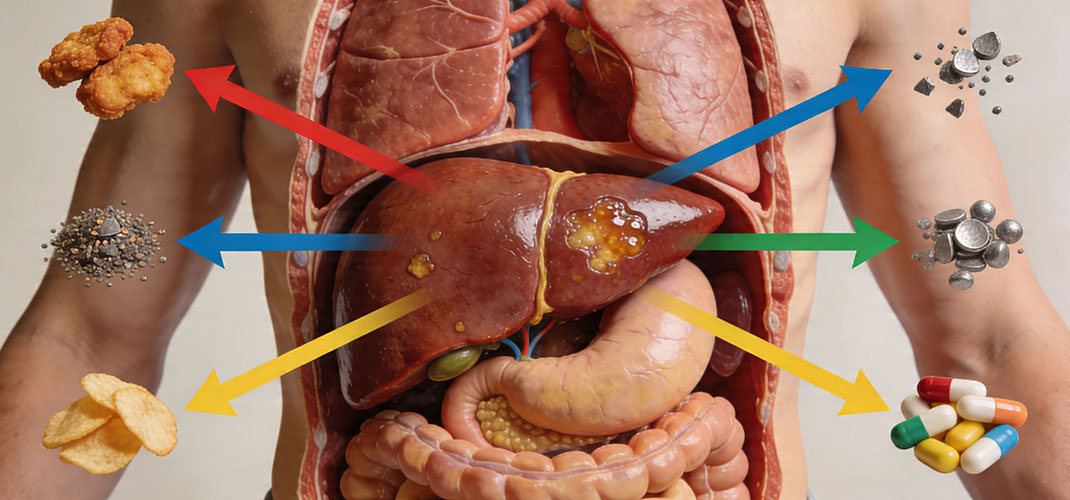 Recent scientific studies show that these very metals may be directly linked to changes in liver function. They promote oxidative stress, disrupt sensitive metabolic processes, and contribute to inflammatory reactions in liver tissue. What makes this particularly insidious is that these burdens rarely occur acutely but build up over years – silently, cumulatively, and often unnoticed for a long time.
The liver attempts to bind, metabolize, and excrete these substances, but its capacity is not unlimited. If chronic overload occurs, a state arises in which toxic influences and metabolic disorders reinforce each other. This is precisely where a mechanism comes into play that is receiving increasing attention in modern research: environmental toxins do not act in isolation, but deeply interfere with the regulation of the entire metabolism and can thus contribute to the development of fatty liver or significantly exacerbate existing processes.
And this also explains why approaches that target the binding and elimination of precisely these substances are increasingly coming into focus. For when substances such as cadmium, lead, mercury, or arsenic are bound in the gut and do not even enter the bloodstream in the first place, the burden on the liver is reduced right at the source – even before it is forced to laboriously process these substances.
Relief at the Source: Why the Action of PMA Zeolite in the Intestines Is Key to Liver Health
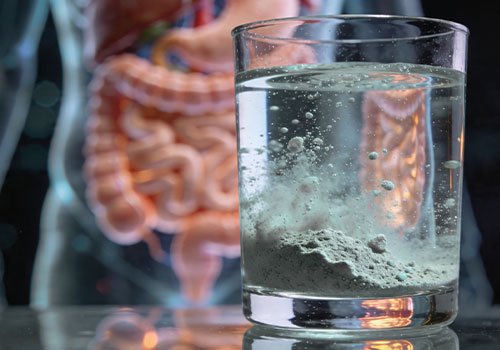 It is important to understand that liver health does not begin in the liver itself. Instead, it begins in the gut, because that is where it is determined which substances enter the body and which do not. This is precisely the point at which the burden on the body either increases or decreases. If harmful substances such as the aforementioned heavy metals, bacterial toxins, or metabolic byproducts enter the body unhindered through a weakened intestinal barrier, a significant portion of them inevitably ends up in the liver, which must process, neutralize, or excrete all these substances.
The liver thus becomes the endpoint of a chain whose origin lies much further back. That is why a modern, cause-oriented approach does not begin where the damage becomes visible, but where it originates. This is where PMA zeolite comes into play – a specially processed form of the volcanic mineral clinoptilolite zeolite, whose effectiveness in heavy metal detoxification has now been proven in numerous clinical studies (see also: Heavy Metal Detoxification: Detoxifying with the Natural Mineral).
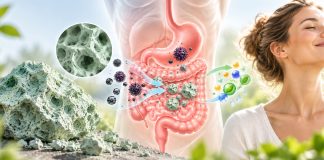
The unique crystalline structure of this aluminosilicate enables it to bind substances that can place a significant burden on the body – including heavy metals such as lead, mercury, cadmium, and arsenic, as well as ammonium, a toxic byproduct of protein metabolism that must be detoxified in the liver. The crucial point here, however, is not so much the binding itself, but rather the location where it takes place. This is because PMA zeolite acts in the intestines – that is, before these substances enter the bloodstream and even reach the liver. Put simply: The liver is not treated directly, but rather relieved in advance by taking over a significant portion of the work it must perform daily behind the scenes, as none of us are free from environmental toxins anymore. At the same time, the binding of harmful substances by PMA zeolite helps support the integrity of the intestinal barrier (see also: Without a healthy intestinal barrier, nothing works) and thus to promote an environment in which the balance of the entire system can stabilize.
Incidentally, particularly in the field of preventive medicine, PMA zeolite is now also gaining recognition among the medical community as a sensible and fundamental component of treatment plans to indirectly relieve the liver. But even when fatty liver disease is already present, it can contribute—as part of a cause-oriented approach – to relieving the gut-liver axis and reducing the flow of harmful substances from the gut to the liver – not as a substitute for medical treatment of existing fatty liver disease, but as support for the regeneration of the entire system. Incidentally, a zeolite regimen lasting several weeks has proven effective for detoxifying and stabilizing the entire intestinal system, including the liver – see also: The correct dosage, timing, and tips for optimal results.
Health begins earlier than we think: A new perspective on prevention
This fundamental approach to detoxification, relief, and regeneration extends far beyond the topic of fatty liver disease. Current research is increasingly showing that environmental pollutants – from heavy metals to toxins and pesticides in our food, water, and air – are not only involved in the development of liver diseases but also play a far greater role in many so-called lifestyle diseases than was long assumed. What we see today is only the beginning of a scientific understanding that is currently evolving at a rapid pace. The connections between the environment, the gut, metabolism, and chronic diseases are becoming increasingly apparent – and with them, the opportunities to take action ourselves.
For one of the greatest opportunities of our time lies not only in new therapies, but in the realization that we can address the root causes. And that there is much we can do ourselves to relieve our bodies and support them, so that, in the best-case scenario, diseases do not develop in the first place.
Sources and References:
“Global burden of metabolic dysfunction-associated steatotic liver disease, 1990–2023 and forecasts to 2050: a systematic analysis for the Global Burden of Disease Study 2023”The Lancet Gastroenterology & Hepatology (2026)
This large-scale analysis shows that as early as 2023, approximately 1.3 billion people worldwide were suffering from metabolic dysfunction-associated steatotic liver disease (MASLD) – an increase of over 140% since 1990. The forecast is particularly alarming: By 2050, 1.8 billion people could be affected, with high blood sugar levels, obesity, and metabolic factors identified as the primary drivers. At the same time, the study shows that the disease is increasingly affecting younger people and spreading rapidly worldwide.
“Global epidemiology of nonalcoholic fatty liver disease—Meta-analytic assessment of prevalence, incidence, and outcomes”Journal of Hepatology / ScienceDirect
A comprehensive analysis of the global epidemiology of fatty liver disease shows that it is one of the most common chronic liver diseases worldwide and is increasingly associated with serious complications such as cirrhosis, liver cancer, and cardiovascular events. Particularly relevant is the finding that a significant proportion of mortality is not caused directly by the liver itself, but by systemic consequences of the disease.
Link: https://www.sciencedirect.com/science/article/pii/S0168827823001940
“Global, regional, and national burden of nonalcoholic fatty liver disease and its attributable risk factors from 1990 to 2019:
Results from the Global Burden of Disease Study”Scientific Reports / Nature (2025)
This analysis based on GBD data shows that the burden of nonalcoholic fatty liver disease is steadily increasing worldwide, with both mortality and disease burden rising significantly. The study emphasizes that fatty liver disease is closely linked to metabolic risk factors and is increasingly recognized as a global health threat. Of particular note is the significant rise in deaths from complications such as cirrhosis and liver cancer.
“Metals exposure and biomarkers of liver damage: a systematic review and meta-analysis of observational studies”. Reviews on Environmental Health (2026)
This systematic review with meta-analysis of 39 studies demonstrates the direct links between environmental exposure to arsenic, cadmium, mercury, and lead and liver damage. Of particular importance: All four metals are associated with elevated liver enzymes, with cadmium having the strongest association, followed by lead and mercury. This study shows how environmental metals can cause long-term damage to the liver.
Link: https://www.degruyterbrill.com/document/doi/10.1515/reveh-2025-0089/html
“Toxicant-associated steatohepatitis in vinyl chloride workers”. Hepatology (2010)
Although this now-classic study is older, it is groundbreaking, as it was the first to examine the links between environmental toxins and liver disease. The authors also coined the term TASH – toxicant-associated steatohepatitis – which has since become standard in the scientific community. The study demonstrates that fatty liver disease, or steatohepatitis, can arise not only from metabolic or alcohol-related causes but also from environmental toxins and occupational exposures.
“Endotoxins and Non-Alcoholic Fatty Liver Disease”. Life (Basel) (2021)
This study shows that a leaky gut, bacterial endotoxins, and dysbiosis can directly affect the liver via the portal vein and thus contribute to the development and progression of fatty liver disease.