Science discovers the intestinal barrier as the previous “missing link” – why the microbiome cannot function without it and what PMA zeolite has to do with it
Much is now known about the microbiome and the various intestinal axes, but here too, as always, science had a very long lead time. As early as the 1950s, researchers began to understand that the gut is not just a “simple” food processor, but one of the most complex control organs of our entire organism – in the truest sense of the word.
However, it was not until decades later, around 2015, that all these findings reached the general public and since then a veritable hype about the microbiome (and not just the one in the gut) has broken out. There is hardly a health-conscious person who doesn’t take a close look at their microbiome. However, it should be noted that the microbiome is nowhere near as well researched as some advertisements would have us believe.
Scientists currently assume that only around five percent of the microbiome in all its diversity, the complex world of intestinal bacteria and, above all, its functions and their extent have been understood at all. The so-called gut axes, of which we now know about the close connections between the gut and the brain, heart, skin, immune system, metabolism, etc., are also far from being fully understood.
Nevertheless, the microbiome is currently the “star” in the media, health guides and social networks. Probiotics are currently the best-selling pharmacy and drugstore products, while prebiotics and fermented foods are expanding on supermarket shelves.
However, despite all the enthusiasm, many people are unable to get their gut, namely their microbiome, under control, despite a healthy diet and probiotics. The fact that the number of people with irritable bowel syndrome or people who have to live with the symptoms of leaky gut syndrome continues to rise sharply speaks for itself (see also: Zeolith – irritable bowel syndrome (IBS) ).
Scientists have now discovered why this is the case with the help of another “missing link” and have added a central, large piece of the puzzle to intestinal research: the intestinal barrier.
A (still) great unknown: The intestinal barrier – a highly complex protective system and much more than just the “intestinal wall”
Many readers will probably now be thinking “Well, the intestinal barrier is just the wall of the intestine, what’s so special about it?” But this is precisely where widespread ignorance still lies, even among very health-conscious and enlightened people. Because this seemingly inconspicuous structure called the intestinal barrier determines whether our body is protected or permanently stressed.
First things first: if the intestinal barrier is intact, it forms the basis for a stable microbiome, a functioning immune system and a healthy metabolism. However, if it is weakened, harmful substances, heavy metals and bacterial components can enter the body and trigger silent inflammation. And research is now showing more and more clearly that without a healthy intestinal barrier, even the best microbiome cannot survive in the long term.
So what does the collective term “intestinal barrier” mean in detail?
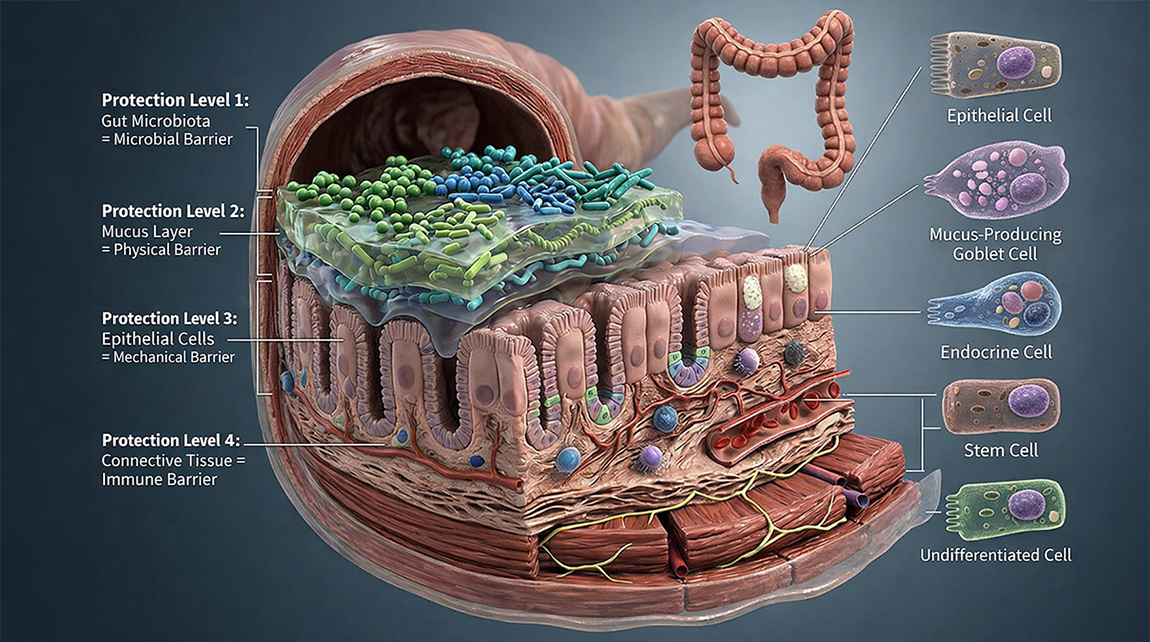 In simplified terms, the intestinal barrier consists of four central layers. The first protective layer begins directly on the surface of the intestinal wall: a viscous mucus layer, also known as mucus, which covers the entire intestinal wall like a protective film. Numerous beneficial bacteria already live in this layer, while at the same time it prevents unwanted germs from coming into direct contact with the intestinal mucosa.
This is followed by a highly active cell layer that is only a few micrometers thick – the so-called intestinal epithelium. This consists of specialized cells that absorb nutrients and at the same time act as a living barrier. The so-called “tight junctions”, tiny connecting structures between the cells that function like precisely regulated zippers, are crucial here: They decide whether and to what extent substances are allowed to pass between the cells and enter the body.
Underneath this cell layer is a dense network of immune cells that constantly checks what has passed through the barrier and reacts immediately if something is wrong. This system is supplemented by the intestinal flora itself, i.e. what we generally understand and mean by the microbiome. This intestinal flora not only lives in the intestinal lumen – i.e. inside the intestine – but is also actively involved in stabilizing the mucus layer and the barrier.
All these layers work closely together like a finely tuned security system – a combination of physical protective wall, biological filter and intelligent control authority that watches over nutrients being absorbed around the clock, while potentially harmful substances are consistently warded off.
When the intestinal barrier becomes permeable – the start of a silent but serious process
But what happens when this finely tuned system becomes unbalanced? If the intestinal barrier is weakened, the tight junctions lose their function, the protective mucus layer becomes thinner and selective control begins to falter. Substances that should actually remain in the intestine – bacterial components, toxins, heavy metals such as lead, arsenic, cadmium, mercury and nickel, pesticides, microplastics or PFAS (perpetual chemicals) or undigested food fragments can suddenly enter the entire bloodstream.
Unfortunately, the result is not an acute alarm that we would feel immediately, but an insidious, insidious process: the immune system is permanently activated and subliminal inflammations develop that can spread throughout the entire body.
These so-called “silent inflammations” often go unnoticed for a long time – and this is precisely where their danger lies. Because while we may still feel healthy, a permanent state of irritation is working in the background, stressing the tissue, disrupting metabolic processes and increasingly exhausting the immune system. Scientific studies now show that such chronic inflammatory processes are associated with a variety of widespread diseases – from metabolic disorders and the resulting diabetes to cardiovascular diseases and neurodegenerative diseases such as Alzheimer’s or Parkinson’s (see also: Disrupted intestinal barrier can be a cause of silent inflammation).
Microbiome and intestinal barrier – an inseparable duo, but with a clear hierarchy
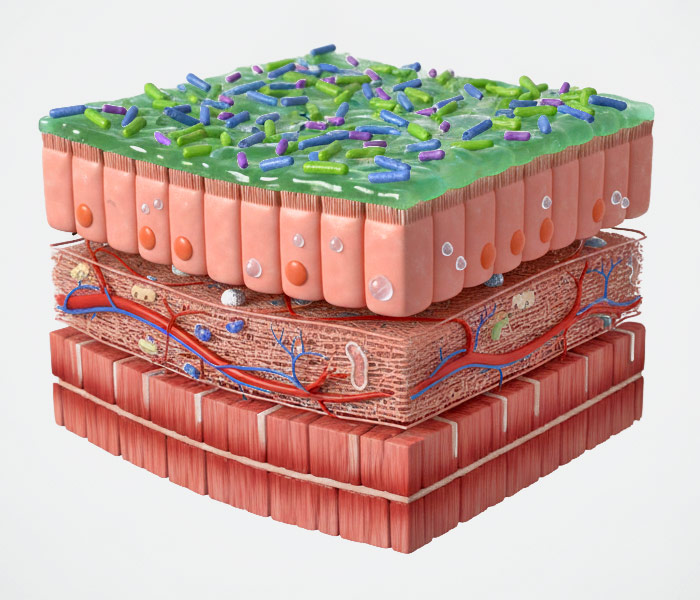 It becomes particularly exciting when the intestinal barrier is placed in relation to the microbiome. Research today shows very clearly that both systems are closely linked and influence each other. Microorganisms stabilize the barrier, while an intact barrier in turn forms the basis for a healthy microbial balance. One cannot exist without the other and their respective states are mutually dependent.
Research has therefore come to a decisive conclusion: A microbiome can only be permanently stable if the intestinal barrier is also intact. Or to put it another way, perhaps even more tangibly: The microbiome is not an independent world. The microbiome is what can only really grow on healthy soil.
This scientifically new finding (remember: in medical research, you calculate in decades, not years), which has been proven in numerous studies, describes the microbiome and the intestinal barrier as a closely intertwined system in which the barrier is the fundamental structural prerequisite.
Environmental stresses: How our current living conditions are unbalancing the gut barrier for many people
However, if we want to understand why the intestinal barrier has become unbalanced in so many people, it is no longer enough to look at diet and lifestyle alone. Another factor is increasingly becoming the focus of research – and this factor is so omnipresent that we often do not (or cannot) consciously perceive it in everyday life: our environment.
The heavy metals already mentioned, such as cadmium, lead, mercury, arsenic and nickel, but also the light metal aluminum, pesticides, particulate matter, microplastics or so-called PFAS – i.e. “perpetual chemicals” – are now an integral part of our modern living environment. They enter our bodies via food, water and air, where they encounter one of the most sensitive systems of all: the intestinal barrier (see also: Removing heavy metals).
A major review from 2025, for example, describes the intestinal barrier in this context as the central interface between the environment and the immune system and comes to a clear conclusion: If this barrier is weakened, pollutants and bacterial components can enter the body and trigger systemic inflammatory processes.
But that’s not all. Other recent studies show that precisely these environmental stresses can have a direct effect on the structure of the intestinal barrier. Oxidative stress, inflammatory reactions and a disruption of the tight junctions lead to the barrier increasingly losing its selective protective function. What should actually remain outside suddenly enters the body – and triggers a cascade of reactions. The intestinal barrier thus becomes a mirror of our environment and its condition a silent indicator of how much stress our organism is already under.
Irritable bowel syndrome and “leaky gut” – two rapidly growing common ailments with a common cause
The consequences of this development can be seen particularly clearly in two real phenomena that have long been underestimated and yet affect millions of people today: irritable bowel syndrome and leaky gut.
Current meta-analyses from the year 2025 assume that around 14% of the world’s population now suffer from irritable bowel syndrome – and the trend is rising. In German-speaking countries alone, there are millions of sufferers and many of them have to live for years without a clear diagnosis or effective treatment
At the same time, the term “leaky gut” is becoming increasingly important. Even if it does not (yet) represent an independent medical diagnosis, it does describe a phenomenon that is becoming increasingly clear in research: increased permeability of the intestinal barrier.
And this is where the circle closes: what was long dismissed as a “functional disorder” or diffuse symptoms can now increasingly be traced back to specific biological processes. These processes – if they go unnoticed, as they often do – can extend far beyond the gut and form the basis for a variety of other chronic diseases. Accordingly, current research should once again clearly draw the attention of the medical profession to the problematic nature of these ailments and diseases and not dismiss them as harmless, albeit painful and life-impairing “minor problems”.
From localized disorder to systemic disease – why the intestinal barrier affects the whole body
Current research shows comprehensively that the intestinal barrier is not isolated, but is the central element of a complex network that affects the entire organism.
Recent reviews show that increased intestinal permeability, as already mentioned, is associated with a variety of chronic diseases – including metabolic diseases such as diabetes, autoimmune diseases, depression and anxiety disorders, neurodegenerative diseases such as Alzheimer’s, other forms of dementia such as vascular dementia and Parkinson’s, as well as multiple sclerosis and, of course, our number one disease: cardiovascular disease.
Even ageing processes are now associated with the integrity of the intestinal barrier. A recent scientific review describes the increasing permeability of the intestinal barrier as a fundamental feature of premature ageing due to its far-reaching effects on the immune system, metabolism and general health.
What becomes apparent here is a further paradigm shift: The gut is not only “involved”, but its barrier is a key pacemaker of our entire biology!
What can we do with these new findings? Relieving the intestinal barrier is the first logical step
If the intestinal barrier is so closely linked to environmental stress, inflammation and chronic diseases, this raises a logical and crucial question: how can we relieve and stabilize this system ourselves? Thanks to the latest research, one thing is clear: it is not enough to “build up” the microbiome if the basis on which it is supposed to exist is disturbed.
It is much more important to take preventative measures in everyday life in order to create the conditions under which this complex system called the “intestinal barrier” can regenerate in the first place. This is where a natural active ingredient that has also been extensively investigated in clinical studies over the past two decades comes to the fore: PMA zeolite.
PMA zeolite – why relieving the intestinal barrier can be a decisive turning point
 PMA zeolite (by the way, we are clearly talking about PMA zeolite and not other clinoptilolite zeolite products, as there are no clinical studies on them) is an extremely interesting approach that has long been used primarily in naturopathy. However, thanks to the consistent study situation (see also: Zeolite studies), this optimized form of volcanic rock has long since arrived in conventional medicine.
Thank heavens, because if we take a consistent look at the latest findings, we can see a (partial) solution that is as simple as it is profound: a damaged intestinal barrier does not regenerate under “constant bombardment”. First of all, it needs fundamental relief. And this is exactly where PMA zeolite comes in.
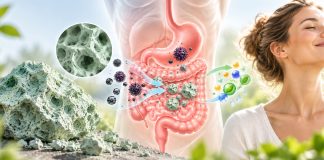
The specially prepared volcanic mineral PMA zeolite (PMA stands for “patented micro-activation”) is a natural aluminosilicate with a highly porous, three-dimensional lattice structure. This unique structure acts like a finely tuned filter system in the intestine: it is able to specifically bind certain harmful substances, including heavy metals such as cadmium, lead, mercury, arsenic and nickel, as well as the light metal aluminum and the metabolic breakdown product ammonium, a form of ammonia (see also: ammonia & ammonium), which is extremely aggressive.
The binding of these toxic substances takes place directly in the intestinal lumen, i.e. precisely where many of these substances have their first and often decisive effect on the intestinal barrier. Instead of being absorbed further into the organism or recirculated in the enterohepatic circulation (i.e. the circulation between the intestine and liver, in which substances are repeatedly returned to the body), they can be bound and excreted naturally.
It is precisely this point that is crucial: by reducing potentially harmful substances, the environment in the intestine changes. Inflammatory processes can subside, oxidative stress is reduced and the intestinal barrier is given the opportunity to stabilize and regenerate.
The scientific studies also show that although PMA zeolite only binds passively and does not intervene directly in the metabolic system and therefore does not burden the human organism, its ability to relieve and regenerate the intestinal barrier can generate antioxidant effects and modulate inflammatory signaling pathways. This means that PMA zeolite does not act in isolation, but is systemically embedded in the complex interaction of the intestinal barrier, immune system and microbiome.
In other words, PMA zeolite can have a real “game changer” effect on many people whose intestinal barrier is disturbed or largely unstable (again, the keywords are irritable bowel syndrome and leaky gut syndrome).
In addition, if the intestinal barrier is stabilized, a biological space is created again for the first time in which beneficial microorganisms can colonize permanently and thus lead to a functioning microbiome. The mucus layer can regenerate, the tight junctions close and the balance in the intestine begins to realign. The PMA zeolite therefore does not start with the symptom, but with the foundation. This is its special significance in the context of modern intestinal research.
Once again, however, it is important to have a clear scientific classification: these effects are linked to the specific, clinically tested form of the medical product PMA zeolite. They cannot be generalized to other zeolite products – this cannot be emphasized enough – as purity, activation, particle size and structure are decisive for the biological effectiveness.
A new look at gut health – first the soil, then life
Let’s summarize the current research on the intestinal barrier: For years, the focus has been on the microbiome – on bacteria, on diversity, on supplementation with probiotics. And of course all of this remains correct and important.
However, it is only now becoming clear that these measures alone are often not enough. Because no microbiome, no matter how good, can establish itself permanently if the soil on which it is supposed to grow is disturbed.
The intestinal barrier is this soil. This is where a new chapter in medicine finally begins, one that addresses the causes and not the symptoms. The intestinal barrier also plays a relevant role in terms of prevention – more important than ever in times of increasing environmental pollution – and completes the study of the microbiome. It is therefore to be hoped that these new scientific findings will be widely disseminated as soon as possible.
Source excerpts – studies and meta overviews on the intestinal barrier from the year 2025:
The gut barrier is not a sideshow – but a key control organ for health and disease.
https://www.sciencedirect.com/science/article/pii/S246812532400390X
Various recent reviews show that an impaired intestinal barrier (“increased permeability”) is directly linked to neurodegenerative diseases (incl. Alzheimer’s, Parkinson’s, multiple sclerosis), metabolic diseases, autoimmune diseases and depression.
https://pmc.ncbi.nlm.nih.gov/articles/PMC12006732
Current research shows that the intestinal barrier works closely with the microbiome. The intestinal epithelial cells form a physical and chemical protective layer, while the microorganisms can actively stabilize it or – in the case of dysbiosis – destabilize it. Without a stable intestinal barrier, there is no stable microbiome.
https://pmc.ncbi.nlm.nih.gov/articles/PMC11914147
A scientific review shows that the intestinal barrier, microbiome and immune system are inextricably linked. The study makes it clear that the stability of the intestinal barrier is decisive for whether the microbiome remains healthy or tips over into an inflammation-promoting balance.
https://pubmed.ncbi.nlm.nih.gov/34858414
Another meta-study shows that an increasing disruption of the intestinal barrier is an evolutionarily conserved feature of ageing. As we age, the integrity of the gut barrier declines, which is associated with changes in the microbiome, increased immune activation, metabolic dysfunction and overall health deterioration. Most remarkably, studies show that targeted stabilization of the intestinal barrier can even extend lifespan.
https://pubmed.ncbi.nlm.nih.gov/37144684
Irritable bowel system: a recent meta-analysis summarizing data from 96 studies and 52 countries shows that irritable bowel syndrome (IBS) affects around 14 percent of the population worldwide. This makes IBS one of the most common functional disorders of the gastrointestinal tract. The symptoms are particularly common in women and in people with stress, anxiety or depression. The study underlines the enormous health and social significance of irritable bowel syndrome and makes it clear that it is a global mass phenomenon.